When public cloud stops working for mission-critical workloads
You probably didn’t notice the moment public cloud stopped working for you. The bill went up, but there was a growth story to justify it.
—

Performance drifted, but stayed within acceptable range. The compliance questions got harder to answer cleanly, but you hadn’t failed an audit yet.
Then something specific happened. Your egress bill spiked during a live event and there was no growth story to match it. Latency variance showed up in your win rate data. A regulator asked who owns the security configuration for a patient portal and the honest answer was that it’s split somewhere between the platform and your team, and nobody wrote it down.
That’s usually the moment.
“The cloud was originally built for efficiency to help companies stop over-investing in hardware just to handle their busiest days. But over time, it became the ‘kitchen sink’ of everything. For organizations scaling AI or managing regulated data, these environments have become so complex and expensive that they’ve lost the very benefits they went to the cloud for in the first place.”
Bob Lyons, CEO of Nexcess
According to the Flexera 2025 State of the Cloud Report, 30% of cloud budgets are wasted, and that number has held steady for years, which tells you it isn’t a configuration problem.
What Specialty Cloud is
Specialty Cloud is purpose-built cloud for mission-critical workloads that general-purpose environments weren’t designed to handle well, where managed accountability, compliance posture, and performance are part of the architecture rather than configured on top of it.
General-purpose cloud gives you compute and a shared responsibility model, then hands you a long list of things to configure. Specialty Cloud starts from the workload’s actual requirements and builds the environment around them.
“Our customers aren’t asking for more complexity; they’re asking for cloud solutions they can trust implicitly. By combining a global data center footprint with natively managed risk, we’ve built an ecosystem where innovation and security coexist.”
Nick Dvas, COO of Nexcess
Who needs it
Not every workload needs the Specialty Cloud. The businesses that do tend to recognize at least one of these situations.
If you’re running workloads under a compliance framework like HIPAA, PCI-DSS, or FFIEC, you already know that “the platform handles that” isn’t an answer. Someone needs to own it on paper. General-purpose cloud’s shared responsibility model works fine until a regulator asks it out loud, at which point it becomes a documentation gap you’re filling in real time.
If your revenue is directly tied to performance at peak load, the tail-latency variance that multi-tenant cloud can produce under pressure isn’t an inconvenience. For a real-time bidding platform it’s a win-rate problem. For a streaming platform it’s a subscriber problem. The math is different depending on your business, but the architecture question is the same.
If you’re trying to move AI out of a pilot and into production, the model isn’t what’s blocking you. Inference workloads need isolation and consistent GPU availability that shared environments weren’t built to guarantee. Most AI projects stall here, not because the model isn’t ready, but because the compute environment underneath it isn’t.
Specialty Cloud vs. public cloud vs. private cloud
The three get used interchangeably in vendor materials, which doesn’t help anyone making an actual decision.
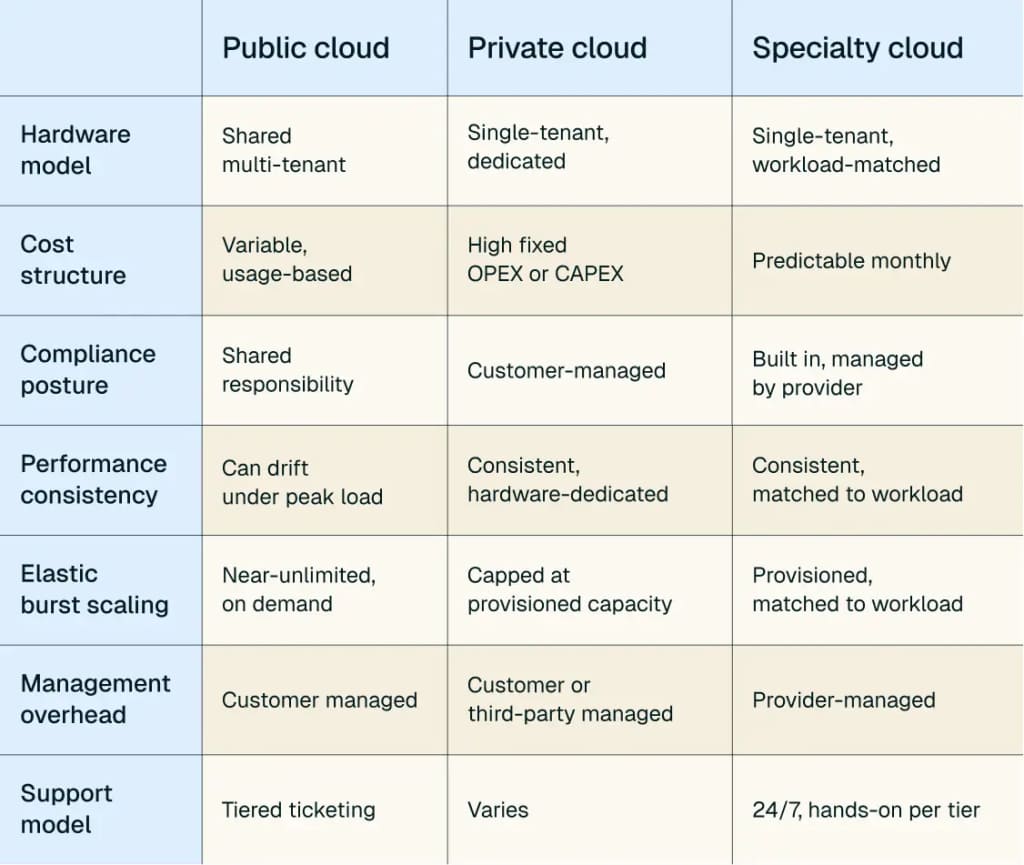
Private cloud gives you dedicated hardware and control. Specialty Cloud adds the managed layer, where someone else owns the operations, the compliance posture, and the performance. The hardware is single-tenant either way. The question is who owns the work on top of it.
If the signals are there
A 2024 Barclays survey found that 86% of enterprise CIOs plan to move at least some workloads off public cloud, and Flexera reports that 21% of cloud workloads have already been repatriated. Most didn’t arrive at that decision through a planning cycle. They arrived because something specific stopped working.
If that’s starting to happen, it’s worth understanding what purpose-built means for your workload. Explore the Specialty Cloud overview or talk to the Nexcess team to see where you fit.
About the author

Most organizations don’t decide to move off public cloud through a planning cycle, something specific stops working first. Gustavo Bordoni works with engineering leaders navigating that inflection point, helping them understand what purpose-built infrastructure means for their workload.
Table of contents
Get hosting news and tips straight to your inbox
Join our community today.
Essential Hosting Resources to help your business stay ahead
Share this page